Ingredients
What’s the best cocoa and chocolate to buy?
By Rashad Bayram · 28 min read · Published · Last reviewed
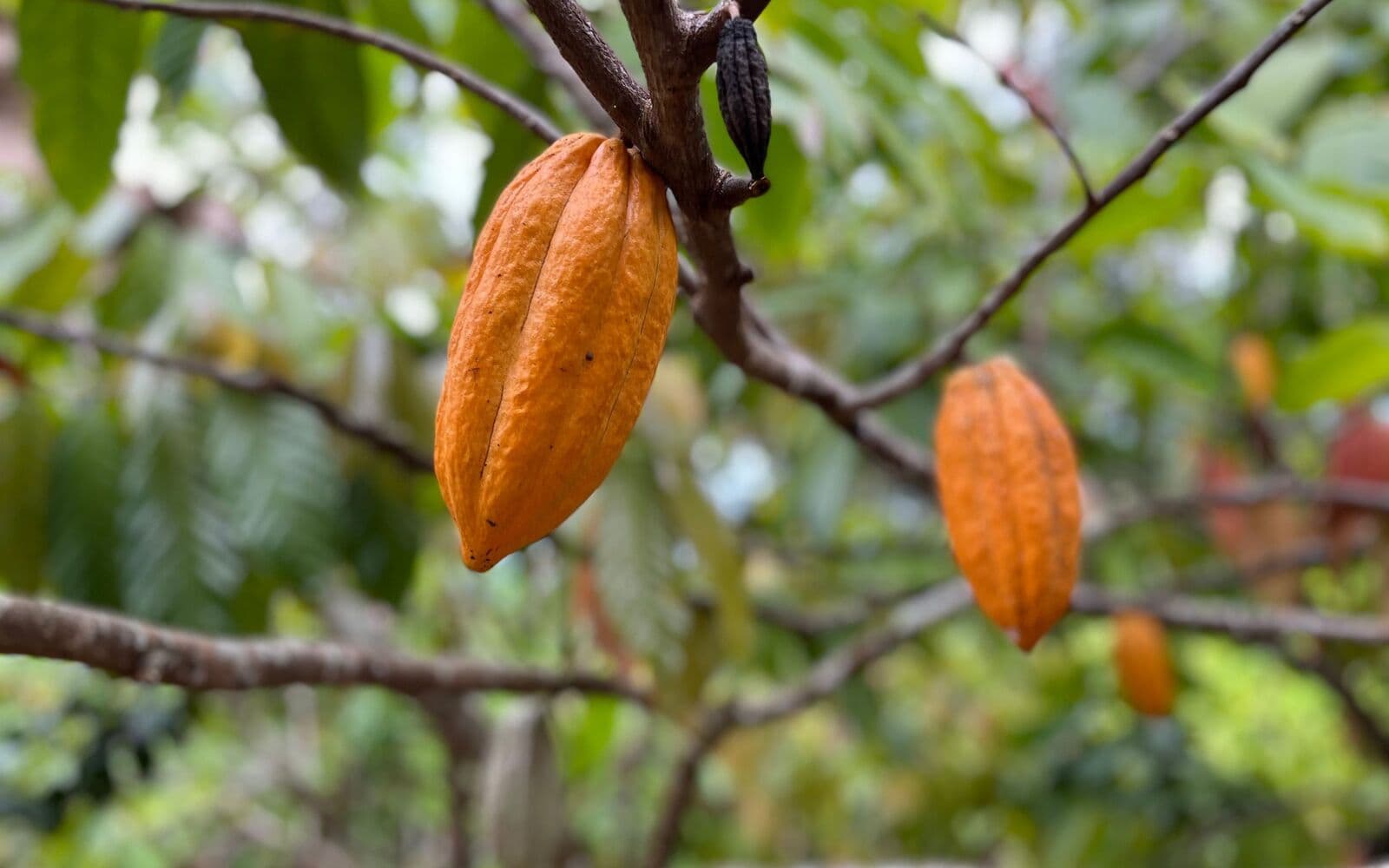
Ripe cacao pods on the tree, Fajardo, Puerto Rico. Photo: Franco Colomba on Pexels (opens in a new tab).
At a glance
What are the key numbers on cocoa?
Growing regions
Where does cocoa grow?
A narrow belt around the equator, mostly within 10° north and south7.
- Fine flavour (2024 list)
- Partly fine flavour
- Previously recognised
- Not on the list
Showing 49 of 49 origins
All origins on the map
Beni River wild cacaoBolivia, Previously recognised (2016–2020), not on 2024 list
Hatched band: the core belt, 10°N to 10°S7; dashed lines: the outer limit, about 20°8. Dots are placed by hand on the region or town (about ±0.5°). Cacao type and flavour show only where I checked a source for that origin; flavour notes describe one lot, not a whole region.
Cacao needs 1,500–2,000 mm of rain a year, 18–32 °C and soil pH 5.0–7.57. Only about 3 in 1,000 flowers become pods, and a tree first fruits after 2–3 years28. It peaks around year 5 and keeps producing for 10–20 more, and about 90% of West African cocoa comes from farms under 5 ha29.
Production by crop year, thousand tonnes
- Côte d’Ivoire
- 1,674 kt
- Ghana
- 449 kt
- Ecuador
- 419 kt
- Nigeria
- 350 kt
- Cameroon
- 320 kt
- Brazil
- 182 kt
- Indonesia
- 180 kt
- Papua New Guinea
- 45 kt
ICCO crop year 2023/24 (October to September). ICCO names only these 8 countries; the rest are “others”5. It has since put 2024/25 world output at 4,728 kt, up 8.4% on its revised 2023/24 figure of 4,362 kt30.
Calendar year 2024, thousand tonnes
- Côte d’Ivoire
- 1,890 kt
- Indonesia
- 633 kt
- Ghana
- 530 kt
- Ecuador
- 404 kt
- Nigeria
- 350 kt
- Cameroon
- 320 kt
- Brazil
- 298 kt
- Peru
- 157 kt
- Sierra Leone
- 94 kt
- Colombia
- 68 kt
- Dominican Republic
- 57 kt
- Uganda
- 55 kt
- DR Congo
- 50 kt
- Papua New Guinea
- 45 kt
- India
- 30 kt
FAO, calendar year 2024, via Our World in Data12. FAO has Indonesia at 633 kt and ICCO at about 180–200 kt: FAO counts calendar years from government reports, ICCO counts crop years. This page uses ICCO.
The 2023/24 shortfall
| Grower | 2022/23 | 2023/24 | Change |
|---|---|---|---|
| Côte d’Ivoire | 2,241 kt | 1,674 kt | −25% |
| Ghana | 654 kt | 449 kt | −31% |
| World | 5,016 kt | 4,368 kt | −13% |
Tonnages from ICCO5; changes are my calculation. ICCO blames October 2023 rain and floods, black pod disease and swollen shoot virus31.
Cocoa price, US$ per kg
- 2023
- $3.28
- 2024
- $7.33
- 2025
- $7.80
- 2026 (forecast)
- $3.80
World Bank annual averages, US$ per kg; 2026 is its April 2026 forecast32,33. Futures hit records on 19 April 2024: US$12,567 a tonne in London and US$11,878 in New York31.
History
How long have people used cocoa?
From an Amazon village to a futures market.
- 1~3300 BCEEarliest known cacao use: Santa Ana–La Florida, upper Amazon of south-east Ecuador (Mayo-Chinchipe culture)6.
- 21900–1500 BCEOldest cacao residue in Mesoamerica, at Paso de la Amada, Chiapas34.
- 31502Columbus seizes a Maya trading canoe carrying cacao beans off Honduras35.
- 41544Dominican friars bring Kekchi Maya nobles to Prince Philip in Spain, with beaten chocolate as a gift: the first recorded chocolate in Europe35.
- 51545In Tlaxcala a turkey hen costs 100 beans and an avocado 1: cacao is money36.
- 61822Cacao reaches São Tomé from Brazil; Bioko (Fernando Po) follows in 185537.
- 71828Van Houten’s press cuts cocoa butter from about 53% to 27%, and he alkalizes the powder: “Dutching”38.
- 81847J.S. Fry & Sons in Bristol make the first mass-produced chocolate bar39.
- 91879Rodolphe Lindt invents conching in Bern (company source)40.
- 101879Tetteh Quarshie starts growing cocoa in the Gold Coast, today’s Ghana (one source says 1869)41,52,42.
- 111977Côte d’Ivoire overtakes Ghana as the biggest grower43.
- 12Apr 2024Cocoa futures hit record highs31.
Types
What are the types of cacao?
Five names you see on labels, and what DNA says about them.
| Type | Share | Origin | Flavour | Grown now |
|---|---|---|---|---|
| Forastero (incl. Amelonado) | ~80% of world chocolate production44 | Amazon basin45 | Bulk cocoa, high yield; ICCO classes it generally bulk45,46 | West Africa, Brazil, Central and South America45 |
| Criollo | Criollo-based fine chocolate: 5–10%44 | Central America45 | Most flavourful, but disease-prone45 | Venezuela, Central America, Mexico45 |
| Trinitario | — | Criollo × Forastero hybrid, Trinidad45 | Fine at its best, hardier than Criollo45 | Trinidad, the Caribbean, Papua New Guinea, Cameroon45 |
| Nacional (“Arriba”) | — | Ecuador; “Arriba” is today’s Los Ríos province47 | Floral; still classed fine46,47 | Coastal Ecuador47 |
| CCN-51 (clone) | ~70% of Ecuador’s 573,000 ha (2018); 54% of Peru’s output47 | Naranjal, Ecuador, about 1960; planted commercially from 198547 | Classed bulk; acidic, bitter, astringent47 | Ecuador, Peru, Colombia47 |
Why CCN-51 spreads: 1,300–1,800 kg/ha against 200–590 kg/ha for Nacional in the same trial47. Yara is a fertiliser company, so I use it only for the plain descriptions.
10 genetic clusters (Motamayor 2008)
DNA work replaced the old “Forastero” catch-all with distinct populations. Trinitario was left out as man-made48.
- Marañón: Peruvian upper Amazon
- Curaray
- Criollo: Central and South America
- Iquitos: Iquitos area, Peru
- Nanay: one locality, Peru
- Contamana: Peru
- Amelonado: lower Amazon; grown in Bahia, Costa Rica, Ghana
- Purús: upper Solimões and Içá River
- Nacional: Ecuadorian Amazon; selected on the coast
- Guiana
In 2026 a study of 390 old farm trees in Peru reported four more lineages, one of them called Porcelana, a different population from Venezuela’s Porcelana49.
ICCO fine-or-flavour exporters, 2024 list
Share of each country’s exports classed fine or flavour; “n.d.” means present, % not yet determined9.
- Brazil100%
- Costa Rica100%
- El Salvador100%
- Grenada100%
- Jamaica100%
- Madagascar100%
- Trinidad & Tobago100%
- Colombia80%
- Nicaragua80%
- Papua New Guinea80%
- Vietnam80%
- Ecuador75%
- Peru75%
- Dominican Republic60%
- Haiti10%
- Indonesia10%
- Cameroonn.d.
- Ghanan.d.
- Malaysian.d.
- Venezuelan.d.
Previously recognised (2016–2020), not on the 2024 list
- Belize
- Bolivia
- Dominica
- Guatemala
- Honduras
- Mexico
- Panama
- Saint Lucia
- São Tomé & Príncipe
All nine were on the 2016 and December 2020 lists11,10 and are not on the current one9. Fine or flavour cocoa is about 12% of world bean exports46.
Process
How do beans become cocoa?
Seven steps, most of them on the farm.
- 1
Harvest
20–50 beans per pod29; about 20 pods make 1 kg of dry beans47,50. Pods are opened within 7–10 days51.
- 2
Ferment
About 5 days for Forastero, 2–3 for Criollo; the heap reaches 40–45 °C in 48 hours51. Ghana: 6–7 days52.
- 3
Dry
Moisture falls from about 60% to 7.5%, at no more than 65 °C51. Sun drying takes 3–5 days53.
- 4
Roast
Cleaned beans are roasted at the factory53.
- 5
Winnow
Beans are cracked and the shells blown off, leaving nibs. US limit: shell at most 1.75%54.
- 6
Grind
Nibs become liquor (mass), 50–60% fat under US rules54. Beans average about 53% cocoa butter55.
- 7
Press or conch
Pressing leaves a cake at about 27% fat, ground to powder38. Conching makes chocolate: 4–12 hours for cheap bars, 3–7 days for premium56.
What’s what: product glossary and legal minimums
| Product | What it is | Canada minimum57 | US minimum54 |
|---|---|---|---|
| Cacao nibs | Shelled, cracked, dried beans | — | Shell at most 1.75% |
| Cocoa liquor (mass) | Ground nibs; no alcohol | — | 50–60% cacao fat |
| Natural cocoa powder | Pressed cake, ground, no alkali | At least 10% cocoa butter (under 10% is “low-fat cocoa”) | 10% to under 22% fat; “breakfast cocoa” 22% or more; low-fat under 10% |
| Dutch-processed powder | Treated with alkali: darker, milder, mixes more easily | — | Alkali capped (3 parts potassium carbonate per 100 parts nibs, or equivalent); label says “processed with alkali” |
| Dark, bittersweet, semi-sweet | Chocolate with little or no milk | At least 35% cocoa solids (18% cocoa butter, 14% fat-free), milk solids under 5% | At least 35% chocolate liquor |
| Sweet chocolate | Less cocoa, more sugar | At least 30% cocoa solids (18% butter, 12% fat-free) | At least 15% chocolate liquor, milk solids under 12% |
| Milk chocolate | With milk solids | At least 25% cocoa solids (15% butter, 2.5% fat-free), 12% milk solids, 3.39% milk fat | At least 10% chocolate liquor, 12% milk solids, 3.39% milkfat |
| White chocolate | Cocoa butter, milk, sugar | At least 20% cocoa butter, 14% milk solids, 3.5% milk fat | At least 20% cacao fat, 14% milk solids, 3.5% milkfat |
Canada moved these standards from the Food and Drug Regulations (B.04, repealed by SOR/2024-244) into CFIA’s Compositional Standards58,57. US figures are from the eCFR text current to 23 October 2026, after the 13 October 2026 amendment to Part 16354. The gap: US milk chocolate needs only 10% liquor; Canada requires 25% cocoa solids.
Cocoa powder
Natural or Dutch-processed cocoa?
Alkali makes cocoa darker and milder, and strips most of its flavanols.
Total flavanols, mg per g of powder
- Natural
- 34.6 mg/g
- Light alkalized
- 13.8 mg/g
- Medium alkalized
- 7.8 mg/g
- Heavy alkalized
- 3.9 mg/g
Total flavanols, mg per g of powder (Miller et al. 2008). The losses, about 60%, 78% and 89%, are my calculation1. In the US, Dutch-processed powder must say “processed with alkali”54.
Here is what the evidence on cocoa flavanols says. EFSA found a cause-and-effect link between cocoa flavanols and normal endothelium-dependent vasodilation at 200 mg a day, which 2.5 g of high-flavanol cocoa powder or 10 g of high-flavanol dark chocolate can provide59. The large COSMOS trial gave older adults capsules with 500 mg of cocoa flavanols a day, not chocolate. Total cardiovascular events were not significantly lower (HR 0.90, 95% CI 0.78–1.02). Cardiovascular deaths were lower (HR 0.73, 0.54–0.98), but that was a secondary outcome, not adjusted for multiple testing, which the authors say should be interpreted cautiously, as hypothesis-generating60. Its COSMOS-Mind and COSMOS-Web studies found no effect on cognition61. Chocolate itself comes with sugar, fat and unknown flavanol levels62. I buy natural powder for its flavour, not as medicine.
Buying
How do I choose good cocoa and chocolate?
Read the ingredient list first, the front of the pack last.
Look for
- Two or three ingredients: cacao or nibs, sugar, maybe cocoa butter. Dick Taylor bars use just nibs and cane sugar63.
- “Cocoa” or “natural cocoa” on the powder, with no alkali listed54.
- 70% rather than 85% when a bar hasn’t been tested: cadmium tends to rise with cacao percentage, though Consumer Reports calls it “not a foolproof measure”2.
- A brand that came out low in an independent test (see the metals tables)2,89.
- A real organic logo with the certifier named. In Canada the logo is allowed only at 95% organic or more64.
Skip
- “Processed with alkali” or “Dutch” when you want the flavanols1.
- “…and vegetable fat coating”: US standard chocolate can’t contain other vegetable fats54, and Canada’s standards allow only cocoa butter and milk fat57.
- Vanillin instead of vanilla: in the US, vanillin not made from vanilla beans counts as an artificial flavour65,66.
- Assuming organic means low metals: the tests say it doesn’t2,3.
- “Raw cacao” as a promise: I found no legal definition in US or Canadian rules, and the beans are fermented, often at 40–50 °C67,51,68.
What each label actually guarantees
| Label | Pesticides and GMOs | Farmer pay | Who checks |
|---|---|---|---|
| Canada Organic | — | None | CFIA-accredited certifier; logo only at 95% organic or more; certifier named on the label64 |
| USDA Organic | No synthetic substances except those on the National List; no GMOs, irradiation or sewage sludge70 | None | Accredited certifiers69 |
| EU organic | No GMOs or irradiation; only authorised plant-protection products71 | None | EU logo only where 95% or more of the farm ingredients are organic72 |
| Regenerative Organic Certified | USDA Organic or equivalent as the baseline73 | A “fairness for farmers and workers” pillar73 | Approved certifiers; Bronze, Silver, Gold73 |
| Fairtrade | — | From 1 Sep 2026, a minimum price of US$3,500/t in Ghana and €3,200/t in Côte d’Ivoire, plus a premium of US$275/t (€250/t)74 | — |
| Rainforest Alliance | — | From October 2025, one premium paid by volume, with a minimum kept for cocoa75 | — |
| B Corp | Not product-level | Not product-level | Certifies the company: a score of 80 or more plus a risk review, re-verified every 3 years76 |
| Non-GMO Project | Not a pesticide standard. Cacao is not on its high-risk list; corn, soy, sugar beets and canola are77 | None | Action threshold 0.9% for human food77 |
| “Direct trade” | No definition in Canadian or US chocolate standards57,54 | — | — |
“—” means the sources I checked don’t cover it. No GM cacao is grown commercially; trials have stayed in labs and greenhouses44.
I use the same rule for salt and flour: read the label, then check who made it. See my natural salt guide and my ancient and heritage grains guide.
Heavy metals
How much lead and cadmium is in chocolate?
Every product tested had some. How much varies a lot by brand.
The limits people quote
| Who | Lead | Cadmium |
|---|---|---|
| California Prop 65 (MADL) | 0.5 µg a day80 | 4.1 µg a day81 |
| US FDA | Interim reference level 2.2 µg a day for children, 8.8 µg for women of childbearing age; not a food limit82 | None for chocolate82 |
| EU (Reg. 2023/915) | No limit for cocoa or chocolate83 | Milk chocolate under 30% dry cocoa solids 0.10 mg/kg; chocolate under 50% (or milk 30% or more) 0.30; chocolate 50% or more 0.80; cocoa powder sold to consumers 0.60. In force since 1 January 201983,84 |
| Health Canada | Keep dietary lead “as low as reasonably achievable”85; no chocolate-specific limit86 | No chocolate-specific limit86 |
Health Canada, as quoted by Global News and CBC in 2023: chocolate makes up less than 5% of dietary exposure to cadmium and lead, and its consumption “does not represent a health concern”86,87. Consumer Reports uses the California MADLs as its level of concern; its tests don’t decide legal compliance88.
Consumer Reports, Oct 2023: 48 cocoa products
| Product | Category | Lead, % of CA MADL | Cadmium, % of CA MADL |
|---|---|---|---|
| Droste Cacao Powder (Dutch-processed)89 | Cocoa powder | 324% | not stated |
| Bob's Red Mill Gluten Free Chocolate Cake Mix89 | Cake mix | 216% | not stated |
| Navitas Organics Organic Cacao Powder89 | Cocoa powder | 77% | 17% |
| Hershey's Milk Chocolate89 | Milk chocolate | 67% | not stated |
| Lindt Classic Recipe Milk89 | Milk chocolate | 11% | 13% |
| CR gives no % for these: described in words, not ranked against the numbers above | |||
| Hershey's Cocoa Naturally Unsweetened89 | Cocoa powder | over the level | not stated |
| Evolved Signature Dark 72%89 | Dark chocolate | over the level | over the level |
| Perugina Premium Dark89 | Dark chocolate | over the level | not stated |
| Hu Dark Chocolate Gems89 | Chips | over the level | not stated |
| Good & Gather Semi-Sweet Mini89 | Chips | over the level | not stated |
| Great Value, Trader Joe's and Nestlé hot cocoa mixes89 | Hot cocoa mix | over the level | not stated |
| Sam's Choice Dark 72%89 | Dark chocolate | below the level | over the level |
| Divine 70% Deliciously Smooth Dark89 | Dark chocolate | below the level | below the level |
| Sam's Choice Dark 85%89 | Dark chocolate | below the level | below the level |
| 365, Kirkland and Nestlé Toll House Semi-Sweet89 | Chips | relatively low | relatively low |
| Feastables Mr. Beast Milk Chocolate89 | Milk chocolate | not stated | 80% |
% of CR’s level of concern per serving; 100% = the MADL. Rows without a stated % sit in their own group. All 48 had detectable lead and cadmium, and 16 were over for at least one metal88. Values from Consumer Reports89,88; “not stated” means CR’s text doesn’t give the number. Test results, not recommendations.
Consumer Reports, Dec 2022: 28 dark bars
- Lower in both metals (5 bars)
- Mast, Taza, Valrhona, Ghirardelli (2)
- Over CR’s level for both (5 bars)
- Green & Black’s, Lily’s, Trader Joe’s, Theo (2)
- Over for at least one metal
- 23 of 28 bars, at 1 oz a day
Groups as Consumer Reports states them2. CR publishes the per-bar numbers only in a chart, so I don’t repeat them here.
- 285 / 469chocolate products over the MADL for lead or cadmium in As You Sow tests since 201490
- 43%of 72 products over the lead MADL, and 35% of the 37 tested for cadmium over that MADL, yet 97.2% under the FDA lead reference level. Organic products had more cadmium, though the authors call the link tenuous, and more certifications didn’t mean less metal. Three of the authors work for ConsumerLab.com3
Consumer Reports suggests children and pregnant people eat dark chocolate “sparingly, if at all”, keep cocoa mixes and brownies occasional, and watch portions of chips89. I measure powder by the level tablespoon.
Brands
Which independent makers would I buy from?
Organic first, then the independents worth knowing.
I list only independent producers: family-owned, founder-owned, or owned by farmers or workers, as their own pages or the press show it. No brands owned by large food companies or investment groups. That is my selection rule, not a claim about anyone else’s chocolate.
Table A · Certified organic, independent
Showing 11 makers
| Brand | Country | Ownership (evidence) | Certification | Cacao origins | Simplest bar | Where to buy |
|---|---|---|---|---|---|---|
| Camino (La Siembra) | Canada | Worker co-op: “independent and worker-owned”, founded 199991,92 | Organic and Fairtrade, all products; certifier not named91 | — | Nightfall 92%: cacao mass, cacao butter, golden cane sugar, ground vanilla beans93 | well.ca, Goodness Me!, Just Us! Coffee164,182,94 |
| Equal ExchangeNamed in an As You Sow Prop 65 notice; no product, date or outcome stated90 | USA | Worker co-op, founded 198695 | USDA Organic via Oregon Tilth; Fair Trade96 | Small-scale farmers in Latin America, incl. the ACOPAGRO co-op, Peru97 | Extreme Dark 88%: chocolate liquor, cocoa butter, raw cane sugar, ground vanilla beans (all organic)96 | US webshop96 |
| Ethiquable | France | Its employees are the only shareholders98 | Organic and fair trade (site claim)98 | 100+ small-producer co-ops98 | — | Mainly France and the EU98 |
| El Ceibo | Bolivia | Federation of 47 co-ops owned by over 1,200 farmer families (2018)100,99 | USDA Organic, Hand in Hand and SSP logos on its site99 | Bolivia; made in Bolivia99 | — | — |
| Zotter | Austria | Family business, about 230 staff101 | EU organic, AT-BIO-402102 | — | Labooko Peru 100%: organic cocoa mass102 | US importer with an online shop103 |
| Vivani | Germany | EcoFinia GmbH: 50% held by Cord Budde, MD of the family-owned Weinrich chocolate maker (its source calls Weinrich the parent company); founder Andreas Meyer is also a shareholder104 | EU organic, DE-ÖKO-013105 | — | Fine Dark 99%: cocoa mass, cocoa butter, coconut blossom sugar (0.5%)105 | — |
| Rapunzel | Germany | Family-owned; its founder says “we are not for sale”106 | EU organic, DE-ÖKO-006107 | — | — | — |
| Giddy Yoyo | Canada (Orangeville, ON) | “100% privately owned Canadian company”108 | Ecocert Canada109 | Peru (“True Criollo”)108 | Hundo 100%: organic cacao (paste, butter), vanilla beans110 | Own webshop; well.ca, Goodness Me!108,110,109 |
| Raaka | USA (Brooklyn) | Co-founders Ryan Cheney and Nate Hodge; “financed only by friends and family” (2020)112 | Organic (site claim)111 | Single origin; buys from Kokoa Kamili, Tanzania111 | 100% Cacao: organic cacao beans, organic cacao butter113 | US webshop111 |
| Prana | Canada (Montréal) | Family-owned; founded 2005 by Alon Farber and Marie-Josée Richer114 | Certified organic; certifier not named135 | — | — | well.ca (cacao powder)135 |
| Organic Traditions | Canada (Toronto) | Founded by Jerry Zeifman; his daughter Ally Mamalider is CEO. Raised a US$10.5M Series A from a group of food executives in July 2026115 | “Certified organic” (site claim)116 | — | — | Own webshop; well.ca116,136 |
“—” means I found no confirmed answer. I couldn’t check certifier IDs in the USDA Organic Integrity Database (it was down on 6 Nov 2026), so certifiers are as printed on labels and product pages.
Table B · Independent, not certified organic
| Maker | Country | Ownership (evidence) | Organic status | Origin | Simplest bar or test |
|---|---|---|---|---|---|
| Ritual | USA (Utah) | Co-founders Anna Seear and Robert Stout; Stout stepped away in 2023117 | “Organically grown cacao” badge, not certified118 | Heirloom single origin118 | Madagascar 75%: organic cacao, cane sugar, cocoa butter119 |
| Hummingbird | Canada (Almonte, ON) | Founded 2012 by Erica and Drew Gilmour, a married couple120 | Products and facility “not certified organic”122 | Beans bought above Fair Trade prices121 | Hispaniola 70%: organic cacao, cane sugar, cocoa butter122 |
| Kasama | Canada (Vancouver) | Founded by four friends, including a father and son123 | No organic claim124 | Philippines (Cagayan Valley, South Cotabato)123 | Tupi 100%: cacao beans, cacao butter124 |
| Qantu | Canada (Montréal) | Founded 2016 by Elfi Maldonado and Maxime Simard; makes bars in its own workshop130 | “Organic quality (not certified)”, per one retailer131 | Four Peruvian co-ops130 | — |
| French Broad | USA (Asheville, NC) | Founders Dan Rattigan and Jael Skeffington125 | No organic claim | Bean-to-bar in Asheville125 | — |
| Divine | UK and Ghana | Co-owned by Kuapa Kokoo cocoa farmers, who share the profits126 | No organic claim; Fairtrade and B Corp126 | Ghana126 | CR 2023: its 70% bar was below CR’s level for both metals89 |
| Marou | Vietnam | Founders Samuel Maruta and Vincent Mourou127 | No organic claim | Made at origin: Ba Ria, Ben Tre, Tien Giang127 | 100% Vietnamese ingredients127 |
| Ki’ Xocolatl | Mexico (Yucatán) | L’Amandine SA de CV; co-founder Mathieu Brees128 | Not organic; Cacao Trace certified128 | Made at origin128 | — |
| Åkesson’s | Madagascar, Brazil, Indonesia | Founder Bertil Åkesson; family estates in Madagascar129 | No organic claim on its site129 | Own plantations129 | — |
Organic natural cocoa powder: the short list
| Powder | Natural (no alkali)? | Certification | Ownership | Size and price |
|---|---|---|---|---|
| Camino Natural Cocoa Powder (Canada) | Yes: the ingredient is “natural cocoa”. Camino’s separate Dutch-processed powder lists potassium carbonate132,133 | Organic and Fairtrade91 | Worker co-op91 | 224 g, CAD 15.79132 |
| Giddy Yoyo Organic Cacao Powder (Canada) | Labelled “Natural”, low-temperature processed134 | Ecocert Canada109 | Private Canadian company108 | 454 g, CAD 29.49134 |
| Prana Organic Natural Cacao Powder (Canada) | “100% organic natural cocoa powder”; alkali not stated135 | Organic135 | Family-owned114 | 200 g, CAD 12.79135 |
| Organic Traditions Cacao Powder (Canada) | Sold as “raw”; alkali not mentioned136 | Organic136 | Founder family; outside investors since 2026115 | 454 g, CAD 25.99136 |
| Equal Exchange Organic Baking Cocoa (US) | No: “processed with alkali” (Dutch)137 | Organic, Fair Trade137 | Worker co-op95 | 8 oz; US$42 for 6137 |
Camino’s natural powder is my pick in Canada: organic, not alkalized, made by a worker co-op. Grenada Chocolate Co. makes an organic powder that isn’t alkalised, but I found no seller in Canada or the US138. Prices checked 6 Nov 2026.
New on the horizon
What is lab-grown and cocoa-free chocolate?
Mostly in factories, not on shelves, for now.
| Company | What it is | On shelves in Canada or the US? | Label words to watch |
|---|---|---|---|
| Voyage Foods (US) | Cocoa-free “chocolate” from upcycled grape seeds, sunflower kernel flour and vegetable fats139 | No: it left retail (reported Sep 2026)140 and sells to manufacturers as NextCoa with Cargill141 | “Cocoa-free chocolate”; “Chocolate*” with “*cocoa-free”139 |
| WIN-WIN (UK) | Fermented cereals and legumes; no cocoa, palm oil or dairy142 | No North American mention; wholesale and foodservice142 | “Cocoa-free chocolate”142 |
| Planet A Foods, ChoViva (Germany) | Fermented ground sunflower seeds, “without any cocoa beans”143 | EU shops through partner brands; no North American mention144 | The “ChoViva” logo on partner packs143 |
| California Cultured (US) | Plant cell-cultured cocoa145 | No. Puratos aims to sell it to US professional bakers by the end of 2026146 | — |
| Celleste Bio (Israel) | Cell-cultured cocoa butter; test milk bars made with Mondelēz147 | No; it aims for market quantities within two years of April 2026147 | — |
As of 6 Nov 2026 I found no cell-cultured cocoa on consumer shelves in Canada or the US. Cocoa-free ingredients mostly go into other companies’ products, so read the list: no cocoa, cacao or cocoa butter means no cocoa.
Shopping
Where can I buy it in Canada and the US?
Alberta first, then the rest of Canada and the US.
Alberta
- Jacek Chocolate Couture148Sherwood Park (factory); shops in Edmonton and St. AlbertBean-to-bar; Costa Rica 70%, Dominican Republic 90%
- Delavoye Chocolate Maker149,150Edmonton, 10639 124 StBean-to-bar single-origin bars, drinks, baking chocolate
- Coppeneur Chocolatier151Calgary, 805 1 St SWCalgary shop of a German bean-to-bar brand; bars, baking chocolate, cocoa powder
- Cococo Chocolatiers152Calgary (Dalhousie, Signal Hill, Southcentre)Chocolatier, not bean-to-bar; Rainforest Alliance couverture
- Blush Lane Organic Market153Calgary; Edmonton (Whyte Ave)Organic grocer: look for certified-organic cocoa and bars
- Community Natural Foods154Calgary (3 stores) and onlineOrganic grocer: look for certified-organic cocoa and bars
Rest of Canada, west to east
- Kasama123Vancouver, BCPhilippine origins
- Sirene155Victoria, BCDirect trade: Chuao, Kokoa Kamili, Semuliki, Alto Beni, Lachua
- Organicfair156Cowichan Valley, BCOrganic bean-to-bar dark chocolate
- Dionisia157Semans, SKBean-to-bar
- Constance Popp158Winnipeg, MBCalled Manitoba’s first bean-to-bar maker
- Soma159Toronto, ONThailand, Nicaragua, Venezuela, Fiji
- Hummingbird121Almonte, ONWorks with farmers; beans bought above Fair Trade prices
- État de choc160Montréal, QCMaker plus a shop with 300+ bars from other makers
- Avanaa161Montréal, QCOrganic and fair-trade ingredients from Latin American farms
- Petite Patrie Chocolate163Kentville, NS, 2 Webster StNova Scotia chocolate maker
- JACOBEAN162Mount Pearl, NLNicaragua (O’Payo)
Online: organic cocoa, nibs and butter
I found no bean-to-bar maker in New Brunswick or PEI.
US: West
US: Mountain
US: Midwest
US: South
US: Northeast
US: National
What you pay per 100 g
| Bar or powder | Kind | Per 100 g |
|---|---|---|
| Soma Brisas 70%159 | Craft | CAD 30.77 |
| Sirene 100% Chuao155 | Craft | CAD 24.29 |
| Soma Chanthaburi 70%159 | Craft | CAD 19.23 |
| Jacek 70% Costa Rica148 | Craft | CAD 15.64 |
| Giddy Yoyo Hundo 100%110 | Organic independent | CAD 12.89 |
| Camino Extra Dark 80%182 | Organic independent | CAD 7.99 |
| Lindt Excellence 70%179 | Supermarket | CAD 8.29 |
| Dick Taylor Belize 72%166 | Craft | USD 21.05 |
| Raaka Ginger Snap111 | Craft | USD 15.69 |
| Ritual Madagascar 75%119 | Craft | USD 14.63 |
| Askinosie 68%170 | Craft | USD 13.53 |
| Lindt Excellence 70%180 | Supermarket | USD 5.02 |
| Hershey’s Special Dark181 | Supermarket | USD 2.29 |
Listed price ÷ weight, before tax and shipping, checked 6 Nov 2026. CAD and USD are not converted. More makers: the International Chocolate Awards winners183 and the Fine Chocolate Industry Association, 140+ members in 25+ countries184.
Fairness
Who gets paid for cocoa?
Most of a bar’s price never reaches the farm.
- 5–6Mcocoa farmers, mostly smallholders185
- ~11%farmer share of a bar’s value; brands and retailers about 70% (French and German market studies, 2018 and 2020)4
- 1.56Mchildren in child labour in Ghana and Côte d’Ivoire cocoa, 2018/19; about 1.48M in hazardous work186
- 30 Dec 2026the EU deforestation rule applies (small operators 30 Jun 2027); deforestation cut-off 31 Dec 2020187,188
Farmgate prices: what the grower is paid
| Season | Ghana | Côte d’Ivoire |
|---|---|---|
| 2024/25 | GH¢48,000/t from 11 Sep 2024, up 129%189; GH¢49,600/t from 8 Nov 2024190 | 1,800 FCFA/kg main crop from 1 Oct 2024191; 2,200 FCFA/kg mid-crop from 2 Apr 2025192 |
| 2025/26 | GH¢51,660/t (Aug 2025)193; GH¢58,000/t from 3 Oct 2025194; cut to GH¢41,392/t from 12 Feb 2026193 | 2,800 FCFA/kg main crop, a record (Oct 2025)196; cut to 1,200 FCFA/kg mid-crop (Mar 2026)197 |
| 2026/27 | GH¢42,400/t from 25 Sep 2026, up 2.4%195 | 1,200 FCFA/kg main crop, from Oct 2026198,196 |
Each government sets its farmgate price: Ghana per tonne in cedis, Côte d’Ivoire per kilogram in CFA francs. Both raised it in October 2025 and cut it in early 2026.
Fairtrade prices for certified cocoa
| Price | Ghana | Côte d’Ivoire |
|---|---|---|
| Minimum price, from 1 Sep 2026 | US$3,500/t74 | €3,200/t74 |
| Fairtrade Premium, from 1 Sep 2026 | US$275/t74 | €250/t74 |
| Organic differential, from 1 Sep 2026 | US$450/t extra74 | €410/t extra74 |
| Living income reference price, from 1 Oct 2025 | US$2.68/kg199 | €2.65/kg199 |
Fairtrade sets these for certified cocoa only; they are not government prices.
Want the cheat sheet?
Get my 1-page apple-water starter cheat sheet, free. One email when there's a new episode or guide, nothing else.
Questions people ask
Is natural or Dutch-processed cocoa better?
It depends on the recipe. Dutch powder is treated with alkali, so it is darker and milder, and some recipes rely on that. Natural powder keeps more of cocoa’s flavanols, a plant compound: in one study heavily Dutched powder had about 3.9 mg/g against 34.6 mg/g in natural powder. I use natural for its flavour.
Is organic chocolate lower in heavy metals?
No. Consumer Reports says not to assume organic dark chocolate is safer, and a 2024 study of 72 products found more cadmium in the organic ones, though its authors call the link tenuous.
Is 70% or 85% dark chocolate better?
For cadmium, Consumer Reports found levels tend to rise with the cacao percentage, so an untested 70% bar is a better bet than 85%, though not a foolproof one.
How much dark chocolate should kids eat?
Consumer Reports advises children and pregnant people to eat dark chocolate “sparingly, if at all”, and to treat cocoa mixes and brownies as occasional.
Is milk chocolate the same in Canada and the US?
No. US milk chocolate needs at least 10% chocolate liquor; Canada requires at least 25% cocoa solids.
Is any cocoa genetically modified?
No GM cacao is grown commercially; research has stayed in labs and greenhouses. Cacao is not on the Non-GMO Project’s high-risk list.
Can I buy lab-grown chocolate yet?
Not as of 6 November 2026. Cell-cultured cocoa isn’t on consumer shelves in Canada or the US, and cocoa-free versions mostly go into other companies’ products.
Sources
- Miller et al. 2008, Impact of alkalization on the antioxidant and flavanol content of commercial cocoa powders, J Agric Food Chem 56(18):8527–33 (opens in a new tab), Europe PMC
- Lead and cadmium in dark chocolate (15 Dec 2022, updated 25 Oct 2023) (opens in a new tab), Consumer Reports
- Hands et al. 2024, Frontiers in Nutrition (72 cocoa products tested) (opens in a new tab), Frontiers
- Comprehensive market study confirms low margins for cocoa farmers (23 Apr 2024) (opens in a new tab), FAO Investment Centre
- Production of cocoa beans, QBCS Vol. LI No. 2 (30 May 2025) (opens in a new tab), ICCO
- Sweet discovery: earliest evidence of chocolate (2018) (opens in a new tab), Phys.org / University of British Columbia
- Growing cocoa (opens in a new tab), ICCO
- Chocolate Lands (opens in a new tab), Cornell University Library
- Revision of Annex "C" of the International Cocoa Agreement 2010 (15 May 2024) (opens in a new tab), ICCO
- Revision of Annex "C" of the International Cocoa Agreement 2010 (Dec 2020) (opens in a new tab), ICCO
- ICCO Panel recognizes 23 countries as fine and flavour cocoa exporters (29 Jun 2016) (opens in a new tab), ICCO
- Cocoa bean production (FAO Production: Crops and livestock products) (opens in a new tab), Our World in Data / FAO
- Kokoa Kamili, grower profile (opens in a new tab), Cocoa Runners (retailer)
- Tanzania Kokoa Kamili, direct trade, organic (bean notes) (opens in a new tab), Chocolate Alchemy (trade)
- Madagascar Sambirano No. 1 (bean notes) (opens in a new tab), Daarnhouwer (cocoa trader)
- How a tiny white cacao bean changed lives in the Piura valley (opens in a new tab), Original Beans (company)
- Bustamante et al. 2022, Front. Ecol. Evol. 10, doi:10.3389/fevo.2022.895056 (opens in a new tab), Frontiers
- Branding matters: the success of Chuao cocoa bean (opens in a new tab), WIPO
- Native cocoa (opens in a new tab), Wildlife Conservation Society Bolivia
- Bolivia wild harvest, Rio Beni (bean notes) (opens in a new tab), Chocolate Alchemy (trade)
- Uganda Semuliki Forest, direct trade, organic, 2024 (bean notes) (opens in a new tab), Chocolate Alchemy (trade)
- Maya Mountain, Belize 70% bar (opens in a new tab), Dandelion Chocolate (company)
- Belize organic 2020 (bean notes) (opens in a new tab), Chocolate Alchemy (trade)
- Recommended Cacao Varieties Tested in Hawaiʻi, FN-59 (Apr 2021) (opens in a new tab), University of Hawaiʻi CTAHR
- Firetree Solomon Island Guadalcanal 82% (opens in a new tab), Bar & Cocoa (retailer)
- Vanuatu Malekula Island (bean notes) (opens in a new tab), Chocolate Alchemy (trade)
- Diczbalis 2013, Commercialising cocoa growing in North Queensland, RIRDC 13/114 (opens in a new tab), Queensland DAFF
- Pollination and Pods (opens in a new tab), Cornell University Library
- Cocoa (opens in a new tab), IITA
- February 2026 Quarterly Bulletin of Cocoa Statistics (opens in a new tab), ICCO
- Annual Report 2023/2024 (PDF) (opens in a new tab), ICCO
- Commodity Markets Outlook, October 2025, forecast table (PDF) (opens in a new tab), World Bank
- Commodity Markets Outlook, April 2026, forecast table (PDF) (opens in a new tab), World Bank
- Powis et al., Oldest chocolate in the New World (opens in a new tab), Antiquity
- The road to Kisses (review of Coe and Coe, The True History of Chocolate), 19 Sep 1996 (opens in a new tab), The New York Review of Books
- When Money Grew on Trees (opens in a new tab), Cornell University Library
- Lanaud, Motamayor and Sounigo, Cacao, in Genetic Diversity of Cultivated Tropical Plants (PDF) (opens in a new tab), CIRAD
- Coenraad Van Houten (opens in a new tab), Cornell University Library
- Fry's chocolate narrative (opens in a new tab), Bristol Museums
- History (opens in a new tab), Lindt & Sprüngli (company)
- Kuusaana et al. 2021, Studia Historiae Oeconomicae 39, doi:10.2478/sho-2021-0003 (opens in a new tab), Adam Mickiewicz University Press
- Cocoa in Ghana: how it all began (Nov 2024) (opens in a new tab), Swiss National Museum blog
- Losch 2001, OCL 8(6) (opens in a new tab), OCL / CIRAD
- Wickramasuriya and Dunwell 2017, Plant Biotechnol J 16:4–17, doi:10.1111/pbi.12848 (opens in a new tab), Europe PMC
- Cocoa types (opens in a new tab), Yara (fertiliser company, secondary)
- Fine or flavour cocoa (opens in a new tab), ICCO
- Jaimez et al. 2022, CCN-51 review, PeerJ 10:e12676 (opens in a new tab), PeerJ
- Motamayor et al. 2008, Geographic and genetic population differentiation of the Amazonian chocolate tree, PLoS ONE 3(10):e3311 (opens in a new tab), PLoS ONE
- Motilal et al. 2026, Genetic structure of traditional cacao reveals four new genetic lineages in indigenous Amazonian sites in Peru, PLOS ONE 21(7):e0351690 (opens in a new tab), PLOS ONE
- Cacao Production Guide (PDF) (opens in a new tab), Philippines Department of Agriculture, BPI
- Harvesting and post-harvest (opens in a new tab), ICCO
- Cocoa (opens in a new tab), Ghana Cocoa Board (COCOBOD)
- Drying and Manufacturing (opens in a new tab), Cornell University Library
- 21 CFR Part 163, Cacao Products (current text, checked 10 Nov 2026) (opens in a new tab), eCFR (US)
- Cocoa Powder, Dark, Milk and White Chocolate (opens in a new tab), Cornell University Library
- Chocolate for Eating (opens in a new tab), Cornell University Library
- Canadian Food Compositional Standards, Volume 4 (opens in a new tab), CFIA
- Food and Drug Regulations, Part B (B.04 repealed by SOR/2024-244) (opens in a new tab), Justice Laws Website
- EFSA Journal 2012;10(7):2809, opinion on a cocoa flavanol health claim (opens in a new tab), EFSA
- Sesso et al. 2022, COSMOS cocoa flavanol trial, Am J Clin Nutr 115(6):1490–1500 (opens in a new tab), Europe PMC
- COSMOS results (COSMOS-Mind, COSMOS-Web) (opens in a new tab), COSMOS trial
- You want chocolate? You need flavanols (Sep 2025) (opens in a new tab), Harvard Gazette
- FAQ (opens in a new tab), Dick Taylor Craft Chocolate (company)
- Organic claims (opens in a new tab), CFIA
- 21 CFR 169.175, Vanilla extract (opens in a new tab), eCFR (US)
- Hallagan and Drake 2018, vanilla and vanillin labelling paper (PDF) (opens in a new tab), Perfumer & Flavorist / FEMA
- Ordoñez-Araque et al. 2020, Foods and Raw Materials 8(1):155–162 (PDF) (opens in a new tab), Foods and Raw Materials
- The truth about raw chocolate (opens in a new tab), Chocolate Alchemy (trade)
- Organic regulations (opens in a new tab), USDA AMS
- 7 CFR 205.105, Allowed and prohibited substances, methods and ingredients (opens in a new tab), eCFR (US)
- Regulation (EU) 2018/848 on organic production (opens in a new tab), EUR-Lex
- The organic logo (opens in a new tab), European Commission
- Regenerative Organic Certified (opens in a new tab), Regenerative Organic Alliance
- Fairtrade boosts support for cocoa farmers amid continuing market uncertainty (11 Dec 2025, edited 7 Sep 2026) (opens in a new tab), Fairtrade International
- Race to the top: our new approach to shared responsibility (opens in a new tab), Rainforest Alliance
- B Corp Certification (opens in a new tab), B Lab
- Non-GMO Project Standard, Version 17, effective 1 Oct 2026 (PDF; the file name says Version 15) (opens in a new tab), Non-GMO Project
- Research: ways lead and cadmium in chocolate can be reduced (17 Aug 2022) (opens in a new tab), As You Sow
- Letort et al. 2025, Cadmium and lead in cocoa, OCL 32:22 (opens in a new tab), OCL
- Lead and lead compounds (opens in a new tab), OEHHA, Proposition 65
- Cadmium (opens in a new tab), OEHHA, Proposition 65
- Lead in Food and Foodwares (opens in a new tab), US FDA
- Commission Regulation (EU) 2023/915 on maximum levels for certain contaminants in food (PDF) (opens in a new tab), EUR-Lex
- Commission Regulation (EU) No 488/2014 (cadmium) (opens in a new tab), EUR-Lex
- Lead (opens in a new tab), Health Canada
- Report on lead and cadmium in dark chocolate, quoting Health Canada (28 Jan 2023) (opens in a new tab), Global News
- Report on lead and cadmium in dark chocolate, quoting Health Canada (2023) (opens in a new tab), CBC News
- Consumer Reports urges Hershey’s to get heavy metals out of chocolate products (Oct 2023) (opens in a new tab), Consumer Reports
- A third of chocolate products are high in heavy metals (25 Oct 2023) (opens in a new tab), Consumer Reports
- Toxic chocolate (opens in a new tab), As You Sow
- Camino (opens in a new tab), Camino / La Siembra Co-operative (company)
- Partners: La Siembra (opens in a new tab), Equal Exchange (company)
- Camino 92% Cacao Nightfall chocolate (opens in a new tab), well.ca (retailer)
- Organic Camino cocoa (opens in a new tab), Just Us! Coffee (retailer)
- About us (opens in a new tab), Equal Exchange (company)
- Organic Extreme Dark Chocolate 88% Cacao (opens in a new tab), Equal Exchange (company)
- Chocolate collection (opens in a new tab), Equal Exchange (company)
- Ethiquable (opens in a new tab), Ethiquable (company)
- El Ceibo (opens in a new tab), El Ceibo (company)
- Bolivian Fairtrade co-op starts distributing gourmet chocolate in the UK (Aug 2018) (opens in a new tab), Co-op News
- Zotter Schokolade (opens in a new tab), Zotter (company)
- Zotter Labooko Peru 100% (opens in a new tab), Violey (retailer)
- Zotter Chocolates US (opens in a new tab), Zotter Chocolates US LLC (importer)
- EcoFinia, Deutscher Nachhaltigkeitspreis press release (Nov 2023, PDF) (opens in a new tab), Vivani / EcoFinia (company)
- Vivani Organic Fine Dark 99% (opens in a new tab), Violey (retailer)
- Rapunzel: new legal form and management (Feb 2025, PDF) (opens in a new tab), Rapunzel Naturkost (company)
- Rapunzel organic highly de-oiled cocoa powder (opens in a new tab), Violey (retailer)
- Giddy Yoyo shop (opens in a new tab), Giddy Yoyo (company)
- Giddy Yoyo 100% raw dark chocolate 62 g (opens in a new tab), Goodness Me! (retailer)
- Giddy Yo organic chocolate bar, Hundo (opens in a new tab), well.ca (retailer)
- Raaka Chocolate (opens in a new tab), Raaka (company)
- Raaka seeks next phase of growth (2020) (opens in a new tab), Nosh (trade press)
- 100% Cacao bar (opens in a new tab), Raaka (company)
- Mission (opens in a new tab), Prana (company)
- Organic Traditions secures $10.5M to accelerate US expansion (Jul 2026) (opens in a new tab), Retail Insider (trade press)
- Organic Traditions (opens in a new tab), Organic Traditions (company)
- Our story (opens in a new tab), Ritual Chocolate (company)
- Ritual Chocolate (opens in a new tab), Ritual Chocolate (company)
- Madagascar 75% (opens in a new tab), Ritual Chocolate (company)
- Meet Erica Gilmour, co-founder of Hummingbird Chocolate (2021) (opens in a new tab), Women of Influence
- Hummingbird Chocolate Maker (opens in a new tab), Hummingbird (company)
- Hummingbird Hispaniola 70% (opens in a new tab), Makerhouse (retailer)
- Kasama Chocolate (opens in a new tab), Kasama (company)
- Kasama Tupi 100% dark chocolate bar (opens in a new tab), ChefShop (retailer)
- Our story (opens in a new tab), French Broad Chocolates (company)
- About us (opens in a new tab), Divine Chocolate (company)
- Our story (opens in a new tab), Marou (company)
- Ki’ Xocolatl (opens in a new tab), Ki’ Xocolatl (company)
- Åkesson’s (opens in a new tab), Åkesson’s (company)
- Qantu, amour et cacao (Feb 2023) (opens in a new tab), Tastet
- Qantu Chocolate Première Fois 100% (opens in a new tab), Chocolats de Luxe (retailer)
- Camino Natural Cocoa Powder (opens in a new tab), well.ca (retailer)
- Camino Dutch-processed cocoa (opens in a new tab), well.ca (retailer)
- Giddy Yo organic cacao powder (opens in a new tab), well.ca (retailer)
- Prana organic natural cacao powder (opens in a new tab), well.ca (retailer)
- Organic Traditions cacao powder (opens in a new tab), well.ca (retailer)
- Organic Baking Cocoa, 8 oz (opens in a new tab), Equal Exchange (company)
- Grenada Chocolate Company pure organic Grenada cocoa powder 170 g (opens in a new tab), Bakery Bits (retailer, UK)
- Voyage Foods (opens in a new tab), Voyage Foods (company)
- Article on Voyage Foods leaving retail (Sep 2026) (opens in a new tab), Green Queen (trade press)
- Cocoa-free confectionery (NextCoa) (opens in a new tab), Cargill (company)
- Alternatives now available (Nov 2023) (opens in a new tab), WIN-WIN (company)
- ChoViva (opens in a new tab), Planet A Foods (company)
- Planet A Foods (opens in a new tab), Planet A Foods (company)
- Cocoa minus the beans: California Cultured plans launch in 2026 (May 2025) (opens in a new tab), AgFunder News (trade press)
- Puratos and California Cultured cell-based cocoa (Feb 2026) (opens in a new tab), Green Queen (trade press)
- Celleste Bio press release (15 Apr 2026) (opens in a new tab), PR Newswire (company release)
- Jacek Chocolate Couture (opens in a new tab), Jacek (company)
- Delavoye Chocolate Maker (opens in a new tab), Delavoye (company)
- Delavoye Chocolate Maker listing (opens in a new tab), Travel Alberta
- Coppeneur Chocolatier (opens in a new tab), Coppeneur (company)
- Cococo Chocolatiers (opens in a new tab), Cococo (company)
- Blush Lane Organic Market (opens in a new tab), Blush Lane (company)
- Community Natural Foods (opens in a new tab), Community Natural Foods (company)
- Sirene Chocolate (opens in a new tab), Sirene (company)
- Organicfair (opens in a new tab), Organicfair (company)
- Dionisia Chocolate (opens in a new tab), Dionisia (company)
- Constance Popp event page (opens in a new tab), Culture Days
- Soma Chocolatemaker (opens in a new tab), Soma (company)
- État de choc (opens in a new tab), État de choc (company)
- Avanaa (opens in a new tab), Avanaa (company)
- JACOBEAN (opens in a new tab), JACOBEAN (company)
- Petite Patrie Chocolate (opens in a new tab), Nova Scotia Buy Local
- Camino brand page (opens in a new tab), well.ca (retailer)
- Dandelion Chocolate (opens in a new tab), Dandelion (company)
- Dick Taylor Craft Chocolate (opens in a new tab), Dick Taylor (company)
- Woodblock Chocolate (opens in a new tab), Woodblock (company)
- Monsoon Chocolate (opens in a new tab), Monsoon (company)
- Nuance Chocolate (opens in a new tab), Nuance (company)
- Askinosie Chocolate (opens in a new tab), Askinosie (company)
- Mindo Chocolate Makers (opens in a new tab), Mindo (company)
- Xocolatl Small Batch Chocolate (opens in a new tab), Xocolatl (company)
- Escazu Chocolates (opens in a new tab), Escazu (company)
- Videri Chocolate Factory (opens in a new tab), Videri (company)
- Fruition Chocolate Works (opens in a new tab), Fruition (company)
- Goodnow Farms (opens in a new tab), Goodnow Farms (company)
- Quality standards (opens in a new tab), Whole Foods Market (company)
- Thrive Market (opens in a new tab), Thrive Market (company)
- Lindt Excellence 70% Cocoa, 100 g (opens in a new tab), Voilà by Sobeys (retailer)
- Lindt Excellence 70% Cocoa, 3.5 oz (opens in a new tab), Walmart (retailer)
- Hershey's Special Dark XL bar (opens in a new tab), H-E-B (retailer)
- Camino Extra Dark chocolate bar 100 g (opens in a new tab), Goodness Me! (retailer)
- Winners (opens in a new tab), International Chocolate Awards
- About FCIA (opens in a new tab), Fine Chocolate Industry Association
- A Global Review of Cocoa Farming Systems (PDF) (opens in a new tab), ICCO
- Assessing Progress in Reducing Child Labor in Cocoa Production, Final Report (Oct 2020, PDF) (opens in a new tab), NORC at the University of Chicago
- Regulation (EU) 2025/2650 amending Regulation (EU) 2023/1115 (opens in a new tab), EUR-Lex
- Regulation (EU) 2023/1115 on deforestation-free products (opens in a new tab), EUR-Lex
- Review of the producer price of cocoa for the 2024/2025 season (11 Sep 2024) (opens in a new tab), Ghana COCOBOD
- Ghana raises cocoa farmgate price again (Reuters, 12 Nov 2024) (opens in a new tab), The Financial Express (Reuters)
- Campagne principale de commercialisation du cacao 2024-2025 (PDF) (opens in a new tab), Gouvernement de Côte d’Ivoire
- Côte d'Ivoire raises purchase price of cocoa beans for farmers (Xinhua, 3 Apr 2025) (opens in a new tab), The Star
- Cocoa producer price cut to GH¢41,392 per tonne from GH¢51,660 (Feb 2026) (opens in a new tab), Citi Newsroom
- Review of producer price for the 2025/26 cocoa season (opens in a new tab), Ghana COCOBOD
- Ghana opens 2026/27 cocoa season with producer price of GH¢42,400 per tonne (Sep 2026) (opens in a new tab), Ghana News Agency
- Ivory Coast maintains farmgate price paid to cocoa farmers (Reuters) (opens in a new tab), ESM Magazine (trade press, Reuters)
- Ivory Coast slashes cocoa farmgate price by nearly 60% amid sales slump (AFP, Mar 2026) (opens in a new tab), Daily Sabah (AFP)
- Prix bord champ du kg du café et du cacao 2026-2027 : 1300 FCFA et 1200 FCFA (Sep 2026) (opens in a new tab), Fraternité Matin
- New Living Income Reference Prices for cocoa in West Africa (29 Jan 2025) (opens in a new tab), Fairtrade International
Showing 10 of 199 sources
This guide explains what the research says in plain words. It is general information, not medical or dietary advice.